
Introduction
When a home flows well, everyday life feels easier, calmer, and more connected. Movement between spaces feels intuitive, natural light is well distributed, and daily routines unfold without friction.
Across both Brisbane and the Gold Coast, we see many homes that struggle not because of size, but because of layout. Even large houses can feel uncomfortable when flow has not been carefully considered.
When improving residential layouts throughout South East Queensland, these are the seven principles of flow we consistently apply to create homes that genuinely support family life.
1.Separating Public and Private Spaces
A well designed family home clearly separates public zones from private zones.
Living areas such as kitchens, dining spaces, family rooms, and outdoor entertaining areas should feel open, social, and welcoming. These spaces form the heart of the home.
Private areas including bedrooms, bathrooms, and studies benefit from being set apart. This creates acoustic separation, improves privacy, and allows different family members to use the home comfortably at the same time.
In Brisbane and Gold Coast homes, this often means living spaces oriented toward gardens, pools, or outdoor areas, while bedrooms are grouped away from main circulation and entertaining zones.
2.Clear, Intuitive Circulation
Circulation refers to how people move through the home. When circulation is designed well, movement feels natural and effortless.
Good circulation avoids unnecessary corridors, awkward detours, and tight pinch points. It supports everyday patterns such as moving from entry to living areas, from kitchen to outdoor spaces, and from bedrooms to bathrooms.
In South East Queensland homes, circulation must also support strong indoor and outdoor movement, particularly in homes with decks, pools, or entertaining terraces.
When circulation works, the home feels calm and efficient. When it does not, daily life can feel constrained and frustrating.
3.Using Light to Support Flow
Natural light plays a critical role in how a home feels and how people move through it.
In Brisbane and the Gold Coast, thoughtful design uses daylight to draw people through the home, reduce reliance on artificial lighting, and improve spatial clarity.
This often includes north facing openings for living areas, carefully positioned windows to bring light deeper into the plan, and courtyards or voids that brighten internal spaces.
Light is not just an environmental consideration. It is fundamental to good flow.
4. Indoor and Outdoor Connection
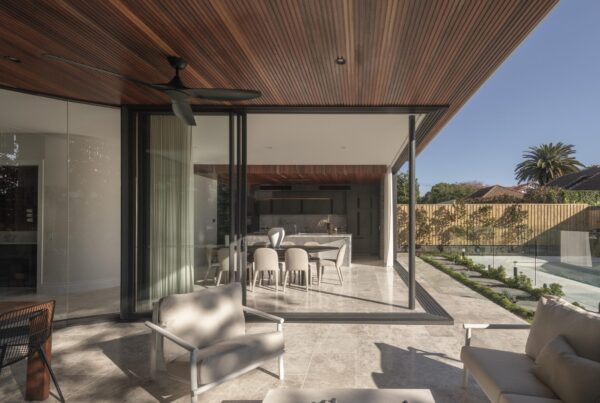
In a subtropical and coastal climate, flow should extend beyond the internal walls.
Strong indoor and outdoor connections allow homes to expand naturally, improve ventilation, and support relaxed family living. This is especially relevant on the Gold Coast, where outdoor areas, pools, and entertaining spaces are often used year round.
Successful indoor and outdoor flow relies on level thresholds, generous openings, and logical relationships between kitchen, living, and outdoor areas.
When designed well, outdoor spaces become a true extension of the home..
5. Strong Lines of Sight
Clear sightlines contribute significantly to comfort and spatial clarity.
Being able to see across multiple spaces helps homes feel open and connected, even when the footprint is modest. This is particularly valuable for families with young children and open plan living arrangements.
Strong sightlines are created by aligning openings, reducing visual clutter, and positioning key rooms so they visually relate to one another.
Good flow depends as much on what you can see as how you move.
6. Eliminating Wasted Space
Wasted space is one of the most common issues we see in residential layouts.
Oversized corridors, unused corners, and poorly resolved transition zones increase construction cost without improving liveability. Well designed homes ensure every square metre contributes to daily life.
Opportunities often include integrating storage into circulation areas, turning transitional zones into study nooks or joinery walls, and reducing duplicated or underused spaces.
This improves flow while keeping homes efficient and cost conscious.
7. Designing for Real Routines
The best homes are designed around real daily routines, not idealised floor plans.
Good flow supports smooth morning routines, easy movement between kitchen, pantry, dining, and outdoor areas, and clear separation between work, rest, and play.
In Brisbane and Gold Coast homes, this often includes accommodating work from home needs, outdoor living, pool access, and flexible family spaces.
When layouts align with real life, homes feel intuitive and enjoyable to live in.
If Your Home Feels Disconnected
If your home feels dark, cramped, or awkward to move through, the issue is often not size but flow.
Through thoughtful re planning, improved circulation, better use of light, and stronger indoor and outdoor connections, many homes across Brisbane and the Gold Coast can be transformed into spaces that feel clearer, brighter, and more comfortable without increasing overall floor area.
Good flow is not about trends. It is about designing homes that genuinely support the people who live in them.